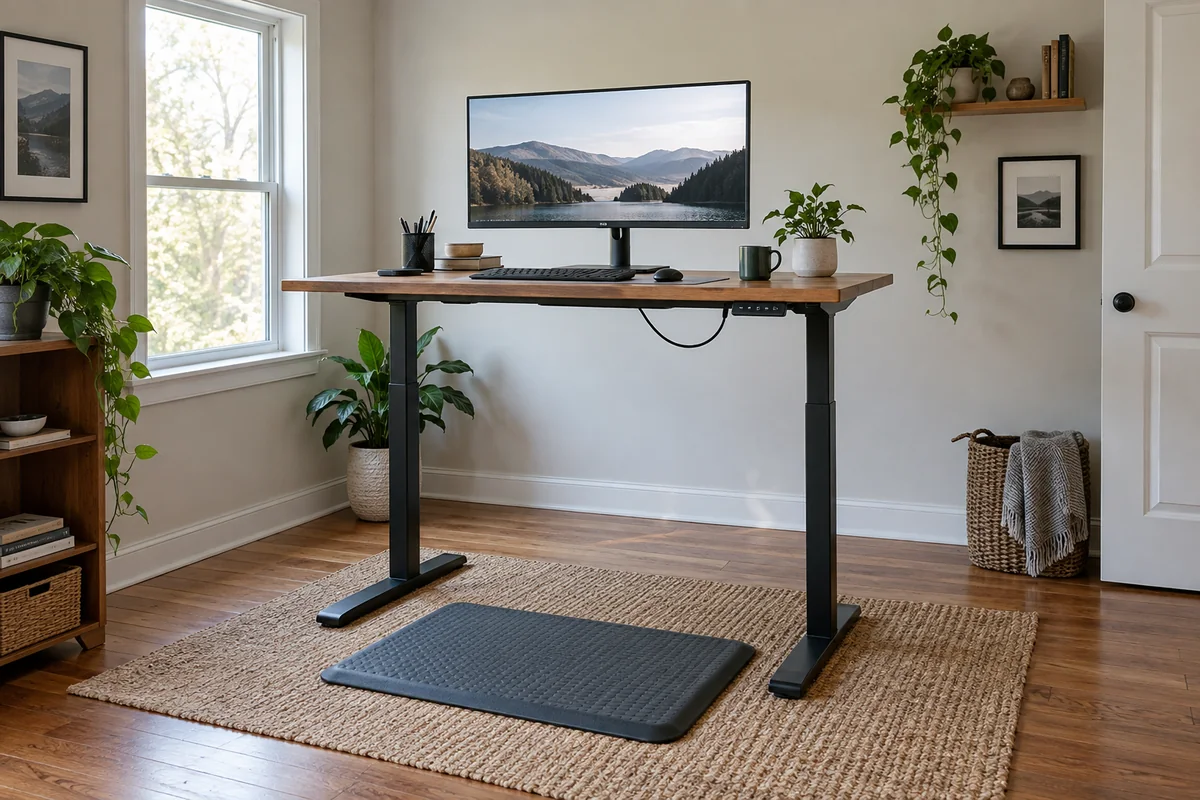
Practical answer
A standing-desk mat is worth considering when the existing floor and footwear feel uncomfortable during short standing periods and the mat does not create a trip edge, block the chair or discourage position changes. It is optional equipment, not permission to stand still for hours.
Test movement habits and footwear first. Then choose a mat by edge profile, firmness, footprint, floor grip, cleaning and where it will go when the chair returns.
- Change position before buying cushioning
- Check the edge and floor grip
- Plan chair and storage movement
- Evaluate footwear and floor together
Decision tree
| Observation | Try first | Mat decision |
|---|---|---|
| Standing periods are long and static | Shorten periods and add movement | A mat does not solve the static routine |
| Hard floor feels uncomfortable quickly | Check supportive footwear and standing duration | Trial a suitable mat if discomfort remains |
| Chair must roll over the same area | Plan mat removal or separate zones | Avoid a mat that becomes a caster obstacle |
| Room has a narrow walking path | Map the edge in the actual route | Skip thick or abrupt edges that create a trip concern |
| Floor is carpeted or uneven | Check manufacturer surface guidance | Grip and edge behavior need a real trial |
What to inspect
- Beveled, visible edges that lie flat in the actual floor environment.
- Enough area for small stance changes without encouraging a fixed spot.
- Firmness that feels supportive rather than unstable; preference and task matter.
- Surface and underside that can be cleaned without damaging the floor.
- A storage position that makes sitting and standing transitions easy.
Run a one-week trial
- Keep standing periods short and tied to appropriate tasks such as a call or review.
- Record whether the mat changes comfort, movement or the likelihood of standing too long.
- Watch the edge during chair movement and normal walking.
- Clean and store it using manufacturer instructions.
- Return it if it complicates movement more than it helps the intended standing periods.
Questions people ask
Do I need a mat on carpet?
Not automatically. Carpet construction, mat grip, edge stability, footwear and standing duration all matter. Follow the mat and flooring guidance.
How thick should an anti-fatigue mat be?
There is no universal thickness in this guide. Thickness interacts with firmness, edge design, balance, floor and task; trial the complete product.
Can I leave the chair on the mat?
Only if the mat is designed for that use and casters remain stable. Many standing mats are easier to move aside before sitting.
Sources and methodology
These sources support the setup logic and boundaries above. Check product-specific instructions before making a purchase or changing electrical equipment.
- Anti-fatigue Mats — Canadian Centre for Occupational Health and Safety ↗Selection factors including flooring, footwear, position changes and trip concerns.
- Sit/Stand Desk — Canadian Centre for Occupational Health and Safety ↗Guidance on alternating positions and workstation adjustment.
- Work Process and Recognition — U.S. Occupational Safety and Health Administration ↗Position variation and recovery-pause guidance.